How to I look into the Agentic AI Roles in India? Having spent over a decade in technical journalism before transitioning into AI Operations, I’ve navigated the rapid industry evolution from basic LLM wrappers to fully autonomous multi-agent systems. As an AI Operations Specialist with a CS Engineering and Tech-MBA background, I regularly audit real-world production deployments and the disconnect between what enterprise engineering teams demand and what job candidates prepare is massive. If you are aiming for an Agentic AI roles in India, here is the ground reality, real interview insights, and how to position yourself to win this race.
Key Headings
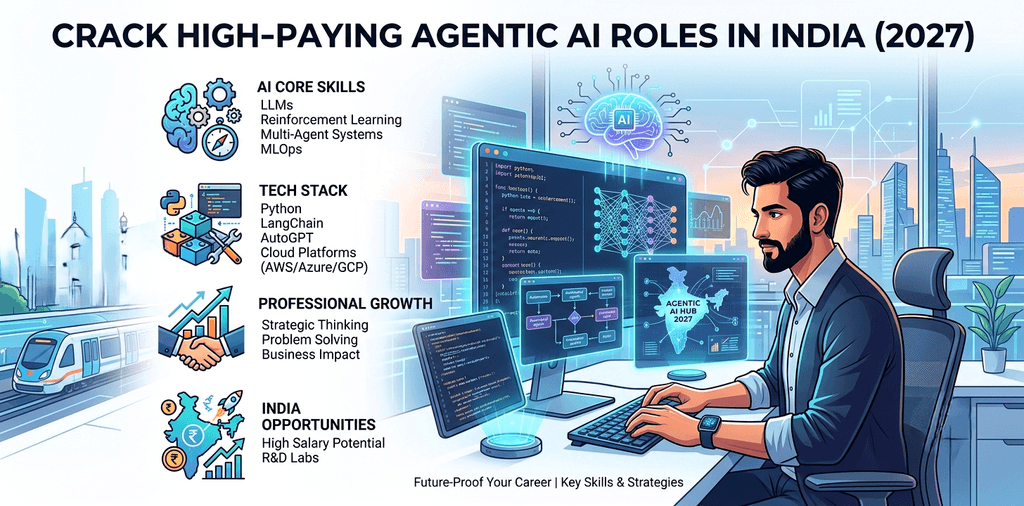
1. Market Reality: 3.5x Talent Gap & City Hubs
India’s demand for specialized AI talent outstrips supply by over 3.5 times. Enterprise demand exceeds 1 million AI professionals, driven heavily by Global Capability Centres (GCCs), FinTech, Healthcare, and IT services giants transitioning from experimental pilots to production workflows.
- Top Hiring Hubs: Bengaluru leads with the highest compensation premium, closely followed by Hyderabad, Pune, Gurugram (NCR), and Mumbai.
- Hierarchy & Experience Salary Bands:
- Freshers / Junior Developers (0–2 yrs): ₹5–12 LPA
- Agentic AI Engineers / Mid-Level (2–5 yrs): ₹12–30 LPA
- AI Workflow Architects / Leads (5+ yrs): ₹30–60+ LPA (Top product firms and GCCs scale up to ₹80L–₹1Cr+ for principal architects)
2. Salary Breakdown: CTC vs. Real In-Hand Pay
A ₹24 LPA offer letter does not translate to ₹2 Lakhs deposited in your bank account every month. Real enterprise compensation breaks down as follows:
| Component | Standard Split (₹24 LPA CTC Band) | Monthly Impact |
| Fixed Base Salary | ₹18,000,000 – ₹20,000,000 / year | Core monthly pay source |
| Performance Bonus / Perks | ₹200,000 – ₹400,000 / year | Variable / Annual payouts |
| Mandatory Deductions | Provident Fund (PF), Tax Deducted at Source (TDS), Professional Tax | ~₹25,000 – ₹35,000 / month |
| Actual In-Hand Pay | ~₹1.15 to ₹1.28 Lakhs / month | Plus joining bonuses, RSUs, or remote allowances |
3. Candidate-Company Gap & Real Production Interview Questions
Most candidates demo toy chatbots or simple single-prompt scripts. Companies want stateful, fault-tolerant agentic graphs that avoid infinite execution loops, handle API rate limits, and maintain budget control.
Actual Questions Asked in Real Interview Rounds:
- Architecture Selection: “When do you choose LangGraph over CrewAI or AutoGen for cyclic multi-agent workflows?”
(Key Answer: LangGraph for fine-grained state persistence and execution cycles; CrewAI for structured role-based task delegation).
- Resilience & Tool Use: “How do you handle API rate limits, tool execution failures, and context window bloating during a multi-step ReAct loop?”
- Safety & Guardrails: “How do you implement Human-in-the-Loop (HITL) authorization steps before an autonomous agent executes a database mutation or financial transaction?”
- Observability: “Which telemetry frameworks (e.g., LangSmith, Phoenix) do you integrate to trace non-deterministic agent decision paths?”
4. Skills, Candidate Pain Points & Vision
- Must-Have Tech Stack: Python, LangGraph, CrewAI, LlamaIndex, Model Context Protocol (MCP), Vector DBs (Pinecone/Qdrant), Guardrails (NeMo/Llama Guard), and async execution.
- Candidate Pain Point: Struggling to demonstrate production-level experience without existing corporate deployment access.
- The Solution: Bridge this gap by building open-source, observable multi-agent systems on GitHub or enrolling in executive programs (e.g., IIIT-Bangalore, IIT Madras/Kharagpur, or DeepLearning.AI- Agentic Workflows).
- Employer Vision:
- Short-Term (12 Months): Automating document workflows, customer triage, and Agentic RAG pipelines to lower operational overhead.
- Long-Term (2027+): Deploying cross-functional, autonomous agent swarms driving enterprise decision-making with governance.
Author Profile
Explore my open-source agentic architecture experiments on GitHub and connect via my Digital Profile to dive deeper into enterprise AIOps!
