Table of Contents
What is the difference between a category sourcing strategy and strategic sourcing?
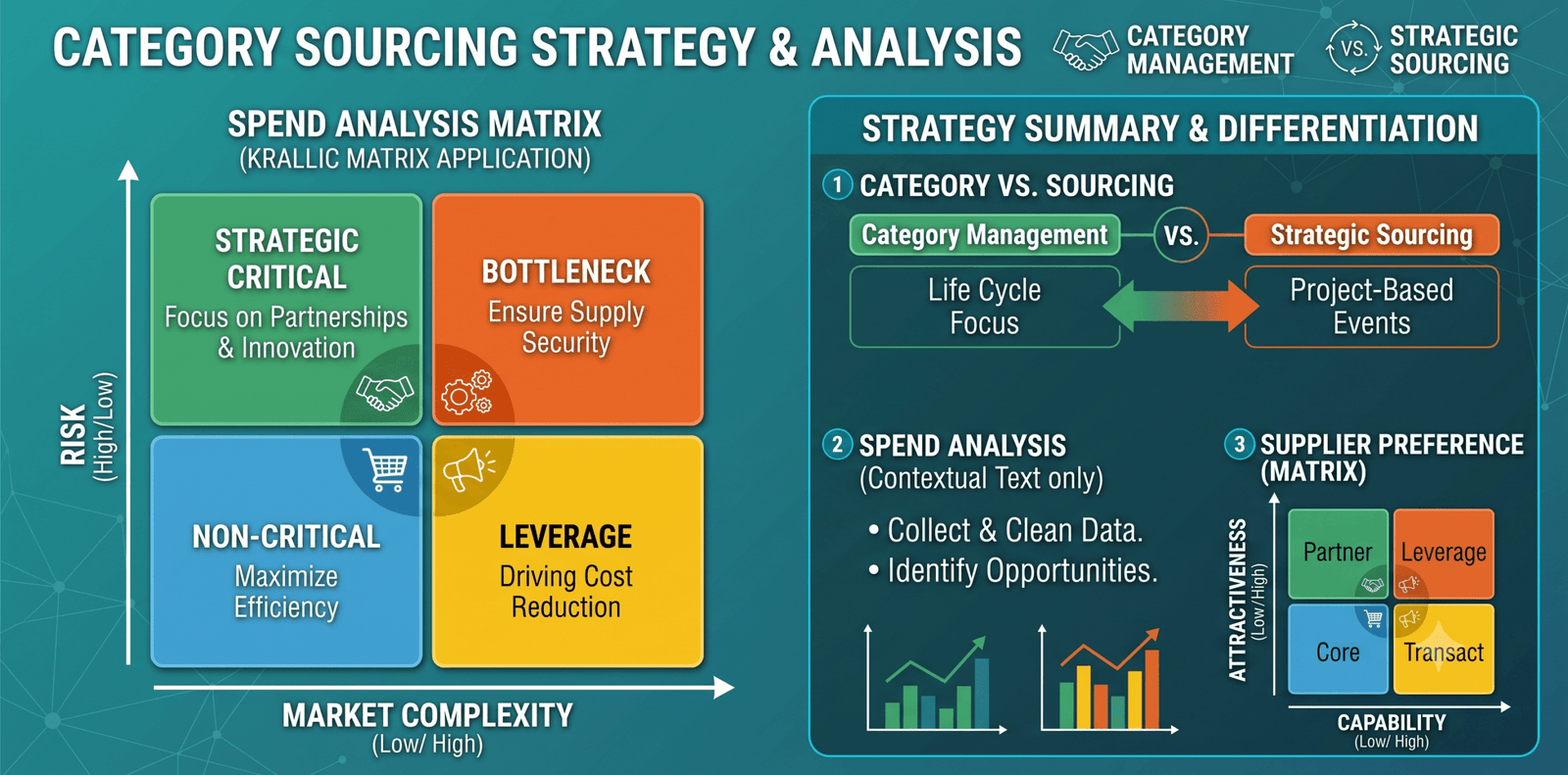
A category sourcing strategy is a continuous, value-driven process focused on managing stakeholder requirements and enterprise risk. In contrast, strategic sourcing is typically a one-time event focused primarily on leveraging purchase volume to reduce transactional unit costs.
Procurement has evolved from a simple transactional purchasing function into a highly strategic business unit. Modern procurement managers don’t just buy goods; they build category sourcing strategies that align stakeholder requirements with supply market realities. By executing a continuous category management workflow, organizations can minimize enterprise risk, improve supplier performance, and drive down the total cost of ownership.
Category Management vs. Strategic Sourcing
While often used interchangeably, category management and strategic sourcing represent different operational scopes. Strategic Sourcing is typically a project-based, one-time event designed to achieve immediate cost savings on specific items. Category Sourcing Strategy, on the other hand, is an ongoing process that manages an entire family of purchases over time, focusing on continuous improvement, stakeholder engagement, and risk mitigation.
Conducting a Spend Analysis
Every effective category strategy begins with a spend analysis. This is an annual review of the firm’s entire set of purchases to determine exactly where capital is allocated. A comprehensive spend analysis answers five basic questions:
- What did the business spend its money on over the past fiscal year?
- Which suppliers received the majority of the business?
- Did divisions pay the contractually agreed-upon prices across all divisions?
- Were purchases correctly budgeted and approved?
- Did we receive the right value and quality for what we paid?
Executing a spend analysis can be difficult due to fragmented databases, mergers and acquisitions, different recording procedures, and incompatible accounting systems. Overcoming these data barriers is essential to unlock procurement insights.
The Supplier Preference Matrix
Once spend data is gathered, category managers use portfolio planning tools to classify suppliers. The Supplier Preference Matrix helps categorize suppliers based on two axes: the attractiveness of the buyer’s account and the relative size of the spend. The table below outlines how categories are defined and managed:
| Relative Spend Level | Low Attractiveness of Account | High Attractiveness of Account |
|---|---|---|
| High Spend | Exploit: Leverage volume to drive concessions, but watch for supplier resistance. | Core: High-value partners. Build deep, collaborative relationships. |
| Low Spend | Nuisance: Low priority. Keep transactions automated and minimal. | Development: Suppliers seeking growth. Nurture to build future capabilities. |
By mapping suppliers to this matrix, category managers can tailor their communication, negotiation, and relationship strategies to match the realities of each supplier relationship.
Final verdict
A reactive approach to purchasing wastes capital and exposes the business to supply chain vulnerabilities. By implementing a continuous category sourcing strategy, executing annual spend analyses, and managing suppliers through the preference matrix, you secure your supply base and maximise purchasing power. Analyse your past year’s spend, classify your supplier database, and align your procurement goals today.
Related posts

4 thoughts on “Procurement Spend Categories: Complete Matrix & Sourcing Guide (2026)”