Table of Contents
How do organizations build supply chain resilience?
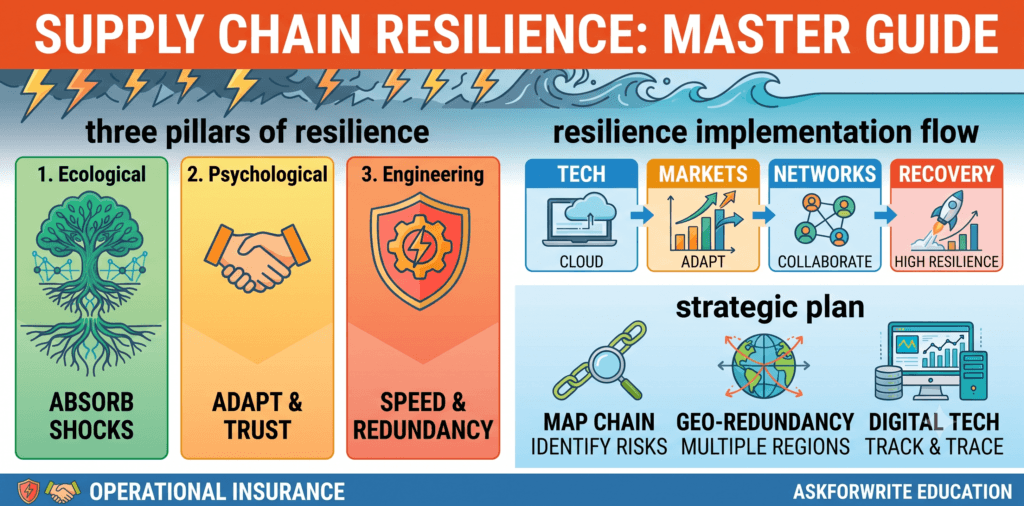
Organizations build supply chain resilience by combining psychological flexibility, redundant sourcing networks, and engineering fail-safes. Learning from post-disaster data, resilient firms adapt by entering new markets, adopting digital tracking systems, and establishing agile communication protocols.
Disruptive events—from natural disasters to global trade wars—are no longer black swan events; they are operational realities. When a supply chain breaks, the impact cascades rapidly, causing factory shutdowns, stockouts, and financial loss. For modern enterprises, building supply chain resilience is a critical requirement to survive and grow in a turbulent business environment.
A Multi-Disciplinary View of Resilience
Resilience is not a single, isolated concept. To build a robust supply chain, managers must draw from multiple scientific disciplines. Each perspective provides unique strategies for absorbing shocks and maintaining functionality:
- Ecological Perspective: Focuses on absorbency and equilibrium. How much disruption can the network absorb before the system changes its underlying structure? The goal is to build a network that can return to a stable state of balance.
- Psychological Perspective: Emphasises human adaptability and stress absorption. It centers on three principles: control, coherence, and connectedness. Strong, trusted relationships with suppliers allow teams to collaborate during crises.
- Engineering Perspective: Measures speed and efficiency of recovery. It focuses on redundancy and design fail-safes, aiming to return the supply chain to its desired operating level as quickly as possible.
Lessons from the Christchurch Earthquakes Case Study
Post-disaster research provides invaluable, empirical data on how organizations adapt under extreme stress. Following the Christchurch earthquakes, researchers tracked the recovery of 541 organizations. The study revealed key operational differentiators that separated surviving firms from bankrupt laggards:
| Operational Metric | Low-Resilience Firms | High-Resilience Firms (e.g. Maori-focused) |
|---|---|---|
| Technological Investment | Froze budgets, relied on legacy systems | Used disruption to invest in new cloud technologies |
| Market Adaptation | Stayed within historical, impacted niches | Adapted quickly; nearly 30% entered new markets |
| Supplier Connectivity | Transactional, price-focused contracts | Connected, collaborative relationship networks |
| Recovery Speed | Delayed, struggled with bottleneck files | Rapid return to baseline productivity levels |
Highly resilient organizations treated the disaster not as a temporary halt, but as a permanent catalyst for structural change. They adapted their systems, diversified their market sectors, and built redundant supplier relationships.
Strategic Implementation Guidelines
Firms must establish proactive risk management protocols. First, map your entire supply chain, identifying sole-sourced components and single points of failure. Second, build geographic redundancy by sourcing critical items from multiple regions.
Finally, leverage technology to improve supply chain visibility. Implementing real-time tracking systems and centralizing inventory databases allows you to detect disruptions early, giving your team the time needed to activate contingency plans before a bottleneck halts production.
The final verdict
Resilience is not an expense; it is insurance for operational continuity. By merging psychological collaboration with engineering redundancy, and learning from post-earthquake data, you build a supply chain capable of surviving any disruption. Audit your supplier dependencies, establish backup sourcing channels, and deploy real-time monitoring tools immediately.
Latest posts


4 thoughts on “Supply chain resilience – Master 1 proven guide”