Table of Contents
Why must organizations pre-define supplier selection criteria?
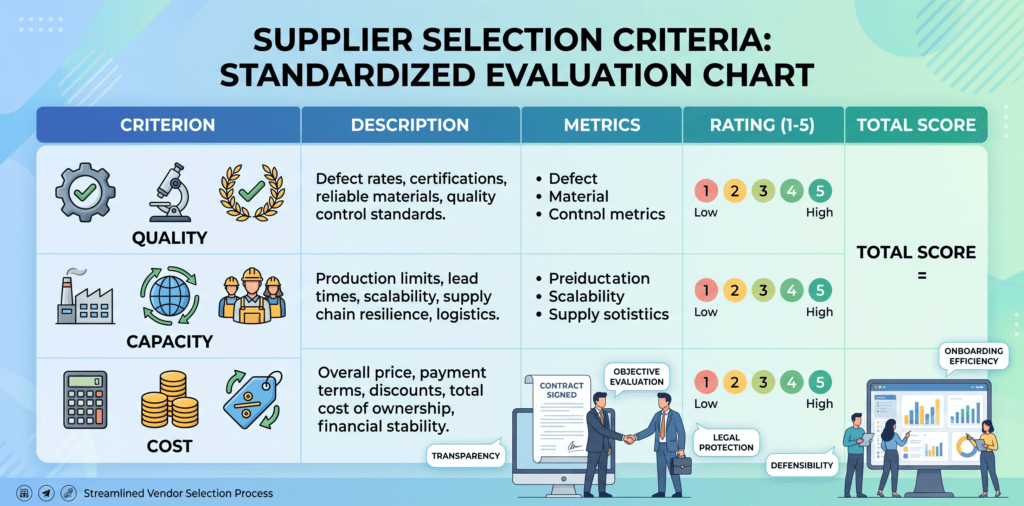
Pre-defining supplier selection criteria ensures objective evaluation and protects organizations from legal disputes. Using a standardized standards chart to rate candidates on quality, capacity, and cost guarantees transparency and defensibility during vendor onboarding.
Choosing the wrong supplier can ruin a project before it even starts. Whether it’s poor quality, delayed delivery, or unexpected cost overruns, supplier failure has massive operational consequences. To protect the organization, procurement teams must implement a structured supplier evaluation and selection process built on pre-defined criteria and objective sourcing alternatives.
Determining your sourcing strategy
There is no single sourcing strategy that fits all business needs. Sourcing decisions must adapt to market conditions, user preferences, and corporate objectives. When developing a strategy, managers must evaluate several operational alternatives:
- Manufacturer vs. Distributor: Buying directly from manufacturers reduces unit costs but requires large purchase volumes. Distributors charge markup fees but offer smaller quantities, storage space, and local logistics support.
- Large vs. Small Suppliers: Large suppliers offer scalability, global presence, and product variety. Small suppliers offer agility, personalised attention, and niche expertise.
- Sourcing Scope: Choosing between local, national, or international suppliers. Local sourcing reduces lead times and logistics costs, while international sourcing provides cost advantages and access to specialized global talent.
Single vs. Multiple sourcing alternatives
One of the most critical decisions in procurement is deciding how many suppliers to onboard for a specific category. Each approach has trade-offs that impact supply chain risk and leverage. The table below compares these alternatives:
| Sourcing Option | Core benefit | Key risk | Best used for |
|---|---|---|---|
| Single Sourcing | Maximum purchase leverage, closer relationships, process integration | Vulnerable to supplier downtime, high dependency | High-value, customized, partner-grade components |
| Multiple Sourcing | Redundancy, active price competition, reduced supply risk | High administrative overhead, fragmented purchase power | Commodities, standardized materials, transactional items |
| Sole Sourcing | Access to proprietary, patented technology | Complete lack of buyer leverage, monopoly pricing | Patented software, proprietary machinery, unique raw materials |
By categorizing suppliers as preferred, certified, or partnered, organizations can align their audit intensity with the strategic importance of the purchased item.
Developing the selection standards chart
Before reviewing a single proposal, the buyer must draft an evaluation standards chart. This chart scores candidates on quality systems, technical capabilities, financial stability, and cost structures. In public or regulated industries, this matrix is a legal necessity. If a rejected vendor challenges the selection, the standards chart serves as objective proof that all candidates were graded on the same scale, defending the decision from accusations of bias.
Final verdict
A rigorous vendor onboarding process is the foundation of a healthy supply chain. By establishing objective supplier selection criteria, evaluating sourcing alternatives, and scoring candidates with standard matrices, you eliminate onboarding bias and minimize operational risk. Draft your vendor evaluation checklist, weight your criteria, and audit your potential supply sources immediately.
Related posts
Master 3 supplier selection criteria – Evaluate sourcing alternatives
Strategic Negotiation Frameworks – Master Supply Chain Procurement



3 thoughts on “Master 3 supplier selection criteria – Evaluate sourcing alternatives”