Table of Contents
What is the Triangle Talk in strategic negotiation frameworks?
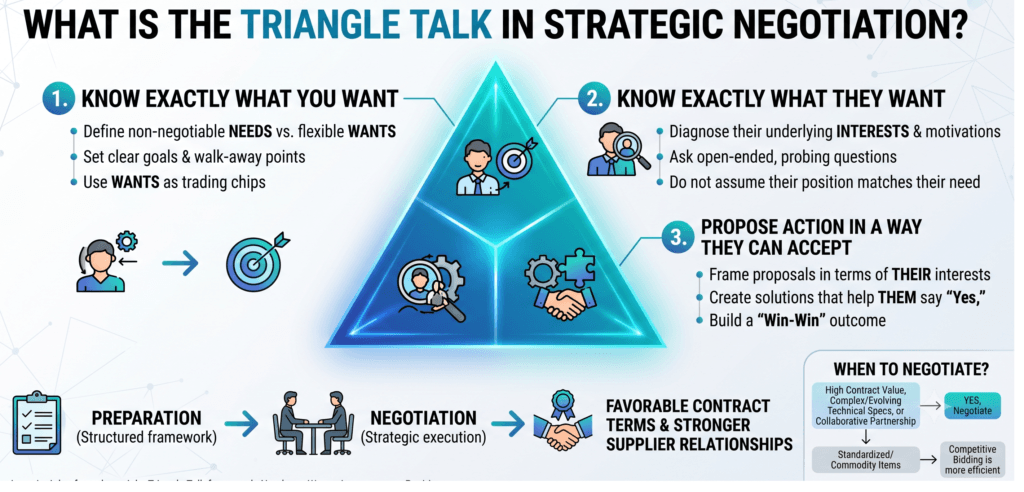
Triangle Talk is a negotiation preparation framework consisting of three steps: knowing exactly what outcome you must achieve (needs vs. wants), diagnosing the underlying motivations of the other party, and framing proposed actions in terms of their interests
Many negotiators go into meetings unprepared, relying on intuition or raw pressure to win concessions. This approach rarely works in supply chain management. When negotiating multi-million dollar contracts with key suppliers, preparation is your biggest source of leverage. By applying structured strategic negotiation frameworks, procurement professionals can secure favourable contract terms while maintaining long-term supplier relationships.
The Triangle Talk methodology
A simple yet highly effective planning tool is the Triangle Talk. It provides a three-step framework to organize your preparation before you sit down at the negotiating table:
- Know Exactly What You Want: Determine and write down your specific goals and objectives. Formalizing these targets keeps you focused and prevents you from making emotional concessions in the heat of the moment.
- Know Exactly What They Want: Diagnose the other party’s needs, constraints, and motivations. Avoid assuming they think like you do. Ask open-ended, probing questions to test your assumptions.
- Propose Action in a Way They Can Accept: Frame your demands in terms of their interests. By showing how your proposal solves their problems, you make it easy for them to say “Yes.”
Needs, wants, interests, and positions
To prepare effectively, you must learn to think like a detective. This requires separating positions from underlying interests and needs from wants. The table below defines these critical negotiation elements
| Negotiation Element | Definition | Key Strategy |
|---|---|---|
| Need | An outcome the negotiator must achieve to close the deal (non-negotiable). | Clearly define your bottom line; walk away if this is not met. |
| Want | An outcome the negotiator would like to have, but is willing to concede. | Use these as trading chips to win concessions from the other party. |
| Position | The specific, opening demand stated by a negotiator. | Avoid locking into positions; look for creative alternatives. |
| Interest | The underlying motivation or reason behind a stated position. | Ask open-ended questions to uncover these hidden motivations. |
Focusing on interests rather than rigid positions allows you to build creative, win-win solutions that satisfy both parties’ underlying needs.
Determining when to negotiate
Not all purchases require a formal, time-consuming negotiation. For standardized, commodity-like items, competitive bidding is more efficient. Negotiation is appropriate when contract values are high, technical requirements are complex and evolving, or the agreement involves collaborative partnerships where issues like intellectual property, quality, and lead times are as important as unit cost.
Final verdict
Negotiation is a science, not an art. By separating needs from wants, identifying underlying supplier interests, and preparing via the Triangle Talk framework, you maximize your negotiation outcomes. Draft your negotiation planning documents, list your concessions, and define your walk-away points before your next meeting.
Other posts


4 thoughts on “Strategic Negotiation Frameworks – Master Supply Chain Procurement”